
DeLand, FL · Garage Door Service
When the Power Goes Out, What Happens to Your Opener
Most DeLand-area homes date to 1986. Here's what that means for openers, power outages, and manual release when the grid goes down.
- Repairs & new doors
- Springs & openers
- Serving 4 nearby communities
How Local Conditions Play In
Housing across the DeLand service area went up mostly between 1976 and 1998, with a median build year of 1986. That one number explains more about opener trouble here than any weather event. A house built in the mid-80s is now 35 to 45 years old, and if the opener has never been swapped, it's original equipment - a chain-drive unit from before battery backup was standard on anything but the premium models.
Across the 15 named areas we work in, the pattern repeats: 1980s and 90s stock, first-generation openers, logic boards and capacitors that have been running three decades longer than anyone planned. The mild temperate climate here actually works in your favor on one front - you don't get the freeze-thaw cycling that cracks housings or stiffens lubricant in colder states. Openers in this area fail from age and electrical wear, not from frost.
What the mild climate doesn't change is what happens when the power drops. An opener without a battery backup is just a motor with nowhere to go when the grid cuts out. In a house built in 1986, there's a good chance that's exactly what's hanging from the ceiling.
The Problem
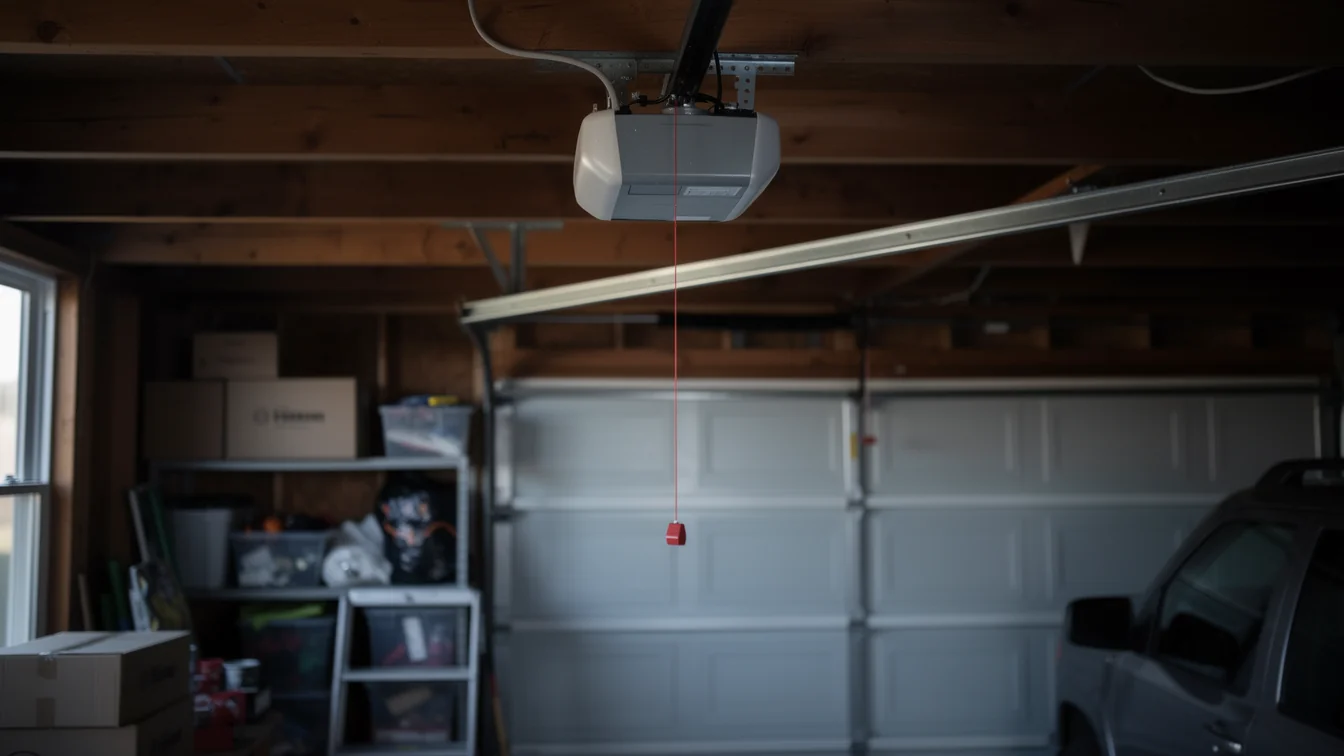
Here's the specific failure: power goes out, and the opener - hard-wired, no backup battery, original to a house from the 1976-1998 building window - simply stops. The door is wherever it was when the lights went. If it was up, your garage is open to the street until power returns or someone manually closes it. If it was down, you're locked out of the car unless you know where the manual release cord is and the track isn't binding.
The second part of the problem is the manual release itself. On an opener that's 30-plus years old, that red cord and the trolley it releases have often never been touched. Grease has hardened, the carriage sticks, and homeowners find out the release doesn't work smoothly on the one night they actually need it.
This isn't a weather problem tied to any one season - it's a stock problem. With 39,980 households and 20,666 owner-occupied houses in the area, and most of that housing dating to the 80s and 90s, a large share of garages are running the same setup: original opener, no backup power, release hardware nobody's exercised in years.
When to Get Help
Call before the next outage, not during it. If you can't locate or operate the manual release right now, in daylight, with no pressure, that's the first sign you need someone to look at it. A release that's stiff or won't disengage the carriage isn't a minor annoyance - it's the only thing standing between you and a door that won't move when the power's out.
If your opener predates battery backup entirely - which is common given the 1976-1998 build window across this area - ask about adding backup rather than waiting for a full failure. It's a smaller job done ahead of time than an emergency call after a storm knocks out power and you're stuck.
Also worth a look: if the opener hums or clicks but the door doesn't move, that's often a worn drive gear or a slipping belt rather than anything to do with power at all. Don't assume every stuck door is an outage problem - on a unit this age, mechanical wear and electrical failure show up together often enough that it's worth having both checked at once.
Leaving It Alone
I'll be straight about this one: not every old opener is worth saving. If yours is original to a house built in the 1976-1998 range - meaning it's comfortably past 25 years, often closer to 40 - and it's already showing more than one symptom, putting a battery backup on it is often money spent on a unit that's going to fail elsewhere within a year or two anyway. At that point a new opener with backup built in costs less over time than a to one patched in pieces.
I also won't tell you every outage is a crisis. If your door was closed when the power dropped, and it stays closed until the lights come back, nothing's actually wrong - you've lost nothing by leaving it. The manual release matters when you need the car and the power's out, not as a rule you have to exercise every outage.
What I can't do is predict how often your power will cut out, or promise a part ships same day - some opener boards for units this old are special order. What I can tell you is that in a service area built mostly in the 80s and 90s, this is the single most common call that starts with 'my door won't move.'
Frequently asked questions
Why doesn't my garage door opener work when the power goes out?
Most openers built before battery backup became standard are hard-wired with no internal power source. When the grid drops, the motor has nothing to run on. Given that most homes in this area were built between 1976 and 1998, a lot of openers still in service predate backup batteries entirely.
Can I add battery backup to an old opener instead of replacing it?
Sometimes, if the rest of the unit is sound. But on an opener that's 30 to 45 years old - common across this area's 1980s and 90s housing stock - the motor, gears, and logic board are often close to failing too, so backup alone may not be the better spend.
Is the manual release cord supposed to be hard to pull?
No. If it's stiff or the carriage won't disengage smoothly, grease has hardened or the trolley has worn. That's worth fixing before you need it in an outage, not after - a release that fails when the power's out leaves you locked in or out.
Does DeLand's climate affect how long openers last?
The mild temperate climate here spares openers the freeze-thaw stress that shortens their life in colder regions. Age and electrical wear are the bigger factors locally, especially given how much of the housing stock dates to the 1980s and 90s.
Related garage door services in DeLand
More garage door guides
Book garage door service in DeLand
Call now or request a quote - tell us what the door is doing and where you are.